


What is it?
St. Paul said to his disciple Timothy: "I remind you to rekindle the gift of God that is within you through the laying on of my hands" (2 Tim 1:6), and "If any one aspires to the office of bishop, he desires a noble task." (1 Tim 3:1) To Titus he said: "This is why I left you in Crete, that you amend what was defective, and appoint presbyters in every town, as I directed you" (Titus 1:5). 1590 CCC
The whole Church is a priestly people. Through Baptism all the faithful share in the priesthood of Christ. This participation is called the "common priesthood of the faithful." Based on this common priesthood and ordered to its service, there exists another participation in the mission of Christ: the ministry conferred by the sacrament of Holy Orders, where the task is to serve in the name and in the person of Christ the Head in the midst of the community. 1591 CCC
The ministerial priesthood differs in essence from the common priesthood of the faithful because it confers a sacred power for the service of the faithful. The ordained ministers exercise their service for the People of God by teaching (munus docendi), divine worship (munus liturgicum) and pastoral governance (munus regendi). 1592 CCC
Since the beginning, the ordained ministry has been conferred and exercised in three degrees: that of bishops, that of presbyters, and that of deacons. The ministries conferred by ordination are irreplaceable for the organic structure of the Church: without the bishop, presbyters, and deacons, one cannot speak of the Church (cf. St. Ignatius of Antioch, Ad Trall. 3,1). 1593 CCC
The bishop receives the fullness of the sacrament of Holy Orders, which integrates him into the episcopal college and makes him the visible head of the particular Church entrusted to him. As successors of the apostles and members of the college, the bishops share in the apostolic responsibility and mission of the whole Church under the authority of the Pope, successor of St. Peter. 1594 CCC
Priests are united with the bishops in sacerdotal dignity and at the same time depend on them in the exercise of their pastoral functions; they are called to be the bishops' prudent co-workers. They form around their bishop the presbyterium which bears responsibility with him for the particular Church. They receive from the bishop the charge of a parish community or a determinate ecclesial office. 1595 CCC
Deacons are ministers ordained for tasks of service of the Church; they do not receive the ministerial priesthood, but ordination confers on them important functions in the ministry of the word, divine worship, pastoral governance, and the service of charity, tasks which they must carry out under the pastoral authority of their bishop. 1596 CCC
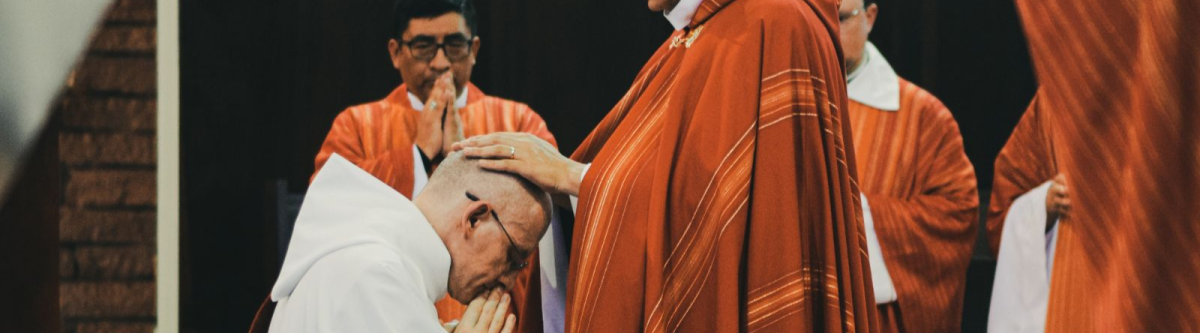
The sacrament of Holy Orders is conferred by the laying on of hands followed by a solemn prayer of consecration asking God to grant the ordinand the graces of the Holy Spirit required for his ministry. Ordination imprints an indelible sacramental character. 1597 CCC
The Church confers the sacrament of Holy Orders only on baptized men (viri), whose suitability for the exercise of the ministry has been duly recognized. Church authority alone has the responsibility and right to call someone to receive the sacrament of Holy Orders. 1598 CCC
In the Latin Church the sacrament of Holy Orders for the presbyterate is normally conferred only on candidates who are ready to embrace celibacy freely and who publicly manifest their intention of staying celibate for the love of God's kingdom and the service of men. 1599 CCC
It is bishops who confer the sacrament of Holy Orders in the three degrees. 1600 CCC
What do I do to receive this Sacrament?
Dear friends in Christ,
On behalf of the Diocese of Colorado Springs, thank you for seeking information on Catholic vocations. Whether you are actively discerning a vocation to the Priesthood, Diaconate, Consecrated Life, or Marriage we hope to provide you with information to help in your discernment. If you are interested in knowing more about the priesthood or the religious life I invite you to contact me, at (719) 866-6486.
In addition you will find resources on this website* and I also encourage you to talk with your Parish Priest or spiritual director.
Assuring you of my prayers for you, I am.
Sincerely yours in Christ,
Most Reverend James R. Golka
Bishop of Colorado Springs